

Now that you have a plan to create your emergency fund and cash reserve, let’s look at how this is going to create a stable foundation for your entire financial plan. The foundation of a house is the load-bearing structure that supports it from underneath. We’re currently renovating a small ranch home and one of the options we had considered was to build a second level on the home to add more room. However, when we dug down to the footings (part of the home that supports the foundation), we found that they were not strong enough to support the extra structure. We realized the importance of the stability of the foundation and it’s just as important to look at the strength of your financial foundation before you start building your financial future as well.
WHAT DOES A FINANCIAL FOUNDATION LOOK LIKE?
If the foundation is the level base where everything above it is a positive cash flow where your income exceeds your monthly & annual expenses and everything below it is negative cash flow (debt), you can see how you want to have a strong support so that when something comes along such as unexpected medical bills or loss of income, your whole structure won’t collapse. They say a picture is worth a thousand words:
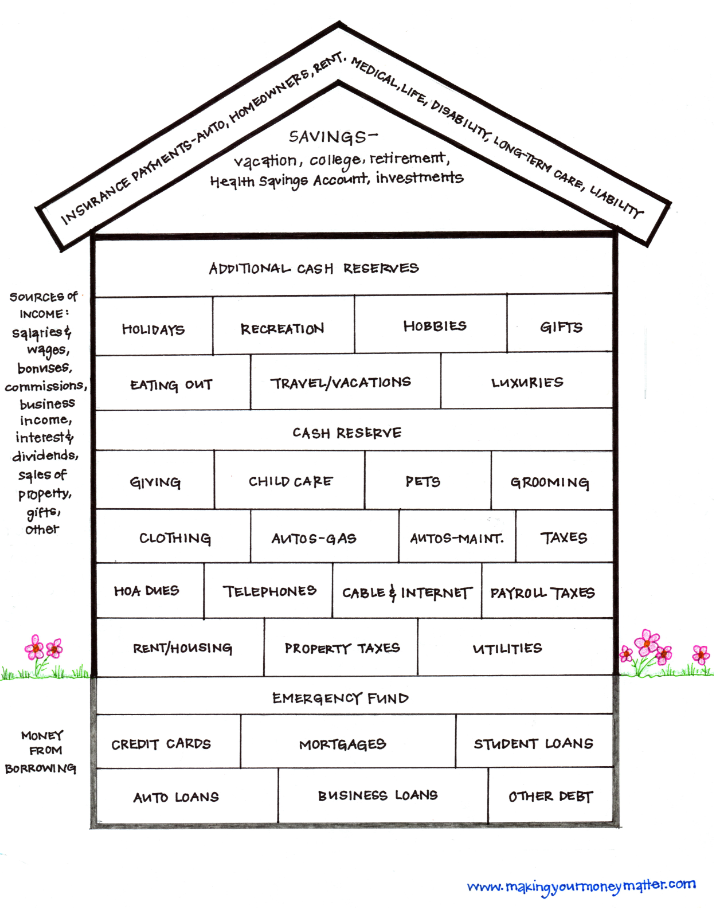 Note that:
- The roof is insurance – The purpose of insurance is to cover you in the case that something unexpected happens that is so expensive that you can’t cover it personally or that you wouldn’t want to take the risk of having to personally pay. For example, most people wouldn’t be able to afford the medical bills if someone in their family had to undergo costly cancer treatments.
- The attic is savings – Any of your extra income that doesn’t go toward bills can go to increasing your ability to pay for unexpected expenses and even luxuries in the future. This includes travel & vacation savings, college savings, IRA’s, retirement, HSA accounts, and anything else you want to save for!
- The attic floor and middle floor are cash reserves – Your cash reserve is going to cover your basic living expenses below such as groceries, rent, utilities, transportation and any other necessary ongoing expense. You should have at least enough to cover basic necessities for at least 3 months, but additional cash reserves will make life more comfortable if faced with something such as a job loss or disability.
- The foundation is the emergency fund – Your emergency fund is going to be the buffer, along with your cash reserve, to make sure that when your income decreases temporarily you don’t have to go into debt to cover the expenses.
EXAMPLES OF WEAK & STRONG FOUNDATIONS
Three varying examples of this would be the following:
A Rickety Shack – This is an example of a family near bankruptcy, where their income is not enough to support their living expenses and debt payments and their entire structure is about to collapse. A step up would be a family that lives paycheck to paycheck and doesn’t have the emergency fund and savings structures in place.
An Average Home – A family that has a healthy basic emergency fund, some cash reserves and some savings set aside for retirement, college and other savings goals has a great structure set up for their home. This family home supports their expenses through their income, rather than through debt, although they may have some debt in the form of student loans, mortgages or auto loans. The average American doesn’t live in an “average home” because they are living paycheck to paycheck without sufficient savings.
A Mansion – The very wealthy generally have multiple income streams and passive income that doesn’t depend on them being employed, which adds a whole additional level of stability. Although their expenses are generally much higher than the average American, they also have so much income that they are the most stable and can support a much larger financial home.
Whether your current financial house is small or large is not as important as the foundation on which it is built. Keep working on building your emergency funds and cash reserves so that you can stay out of debt and weather the financial storms that come your way. Strengthen your foundation to protect your hard-earned assets and your house will keep you safe for a long time to come!
What do you plan to do to build a stable financial foundation?


2 Responses
I liked the analogy! We are somewhere in between the average house and trying to build a mansion. I think once we can get some good passive income, we should be close to that mansion status 🙂
Thanks Casey! Passive income is something I’m working on too. It sure takes a lot of active work to get to that passive income stage ;).